Static and Smoke: Why the Signals You're Chasing On-Chain Are Probably Just Noise

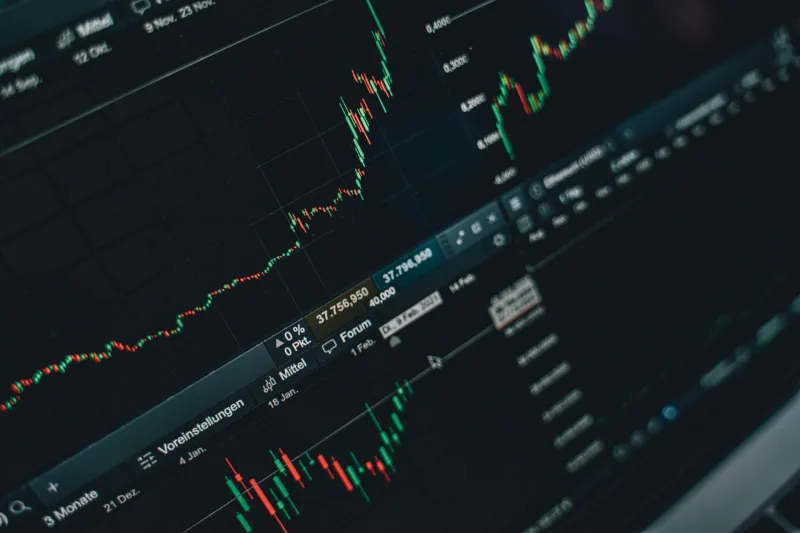
Photo by Photo by Austin Hervias on Unsplash on Unsplash
There's a moment every on-chain bettor knows. You're watching wallet flows, tracking liquidity shifts, maybe running a custom dashboard that aggregates transaction volume across three different protocols. Something catches your eye — a pattern. A repeating shape in the data. It feels like a discovery.
Most of the time, it isn't.
Welcome to the noise floor: the baseline level of random activity that lives inside every decentralized betting market, waiting to fool you into thinking you've found something real.
Your Brain Is Working Against You
Humans are pattern-recognition machines. That's not a flaw — it's the core feature that helped our ancestors survive. But in financial and betting markets, especially ones as volatile as on-chain environments, the same instinct becomes a liability.
Psychologists call it apophenia: the tendency to perceive meaningful connections between unrelated things. In a casino, it's why people think a slot machine is "due." In crypto betting markets, it's why bettors convince themselves that a particular wallet's activity predicts price direction, or that a surge in gas fees signals incoming sharp money.
The data isn't lying to you. You're just asking it the wrong questions.
Decentralized platforms generate enormous amounts of on-chain activity — token swaps, liquidity deposits, contract interactions, oracle updates. Most of that activity has nothing to do with predictive betting signals. It's structural noise: the market breathing. But because it's visible in a way that traditional sportsbook activity never was, bettors assign it meaning it doesn't have.
What Noise Actually Looks Like
Let's get specific. Here are three of the most common false positives retail bettors encounter in on-chain environments:
Liquidity spikes that feel like whale accumulation. When a large amount of capital enters a betting pool, it's tempting to read that as a directional signal — smart money loading up. But liquidity provision and directional betting are completely different actions. A liquidity provider adding capital to a pool is managing yield, not expressing a view on an outcome.
Short-term volume clusters. You notice that betting volume on a particular market spikes in a predictable window — say, 90 minutes before game time on Sunday afternoons. You backtest it. It holds for six weeks. You build a strategy around it. Then it stops working. What you found wasn't an edge. It was a coincidence that survived long enough to feel like a rule.
Wallet correlation patterns. Two high-value wallets seem to move in sync — one bets, the other follows within minutes. Over a dozen observations, the pattern holds. But without understanding why those wallets are correlated, you have nothing. They could be operated by the same entity. They could be reacting to the same public information. The correlation is real; the signal is not.
Regression to the Mean: The Concept That Humbles Everyone
If there's one statistical concept that should be tattooed on every bettor's forearm, it's regression to the mean. In plain terms: extreme outcomes tend to be followed by more average ones, not because of any causal mechanism, but simply because extreme outcomes are rare by definition.
In practice, this means that if you had a hot streak — maybe three winning bets in a row using a new on-chain signal — you're statistically more likely to see that performance cool off than to continue accelerating. The streak felt like evidence your system worked. But the sample size was too small to mean anything.
Decentralized markets are especially brutal here because the feedback loops are fast. You can place a bet, see it resolve, and place another within the same afternoon. That speed creates the illusion of a high-sample-size test when the actual number of independent observations remains tiny.
Building a Filter That Actually Works
So how do you separate genuine edges from expensive false positives? A few principles worth internalizing:
Demand a causal story, not just a correlation. Before acting on any pattern, you should be able to articulate why it should exist. "Volume spikes because informed bettors act before retail" is a causal story. "These two wallets always move together" is not. If you can't explain the mechanism, you don't have a signal.
Stress-test your sample size. As a rough rule, fewer than 50 independent observations of a pattern is not enough to trade on. In fast-moving crypto betting markets, getting to 50 clean data points on a specific setup can take months. Be patient or be wrong.
Track your false positive rate deliberately. Keep a log of every signal you acted on and whether it paid off — not just whether the bet won, but whether the signal actually predicted the outcome. Over time, a genuine edge will show a win rate meaningfully above the baseline. Random noise will regress toward 50%.
Apply signal decay skepticism. On-chain markets attract sophisticated participants who are constantly hunting for the same edges you are. Even legitimate signals have a shelf life. If a pattern becomes widely known, arbitrage erases it. Build in a review period — if a signal stops working for four to six weeks, assume it's dead.
The Expensive Lesson Nobody Wants to Learn Twice
The uncomfortable truth about on-chain betting markets is that they're more transparent than traditional sportsbooks but not necessarily more predictable. Transparency gives you data. Data gives you the opportunity to find edges. But it also gives you a thousand ways to fool yourself.
The bettors who last — the ones who build sustainable on-chain strategies — aren't the ones who find the most signals. They're the ones who ruthlessly discard false positives and operate only when they have genuine, mechanistically defensible reasons to act.
Noise is loud. It looks like information. It feels like an edge. And it costs real money every time you mistake it for something it isn't.
The goal isn't to eliminate uncertainty — that's impossible. The goal is to stop paying tuition for lessons randomness is happy to keep teaching you.